
When a gynecologist says “we will perform a vaginal ultrasound,” many women have similar questions: How is a transvaginal ultrasound performed? Does it hurt? How long does it take? Can it be done during pregnancy?
Not knowing what to expect can cause anxiety, particularly for people who have never had this examination before.
A vaginal ultrasound, also called a transvaginal ultrasound, is a commonly used ultrasound method for assessing the female reproductive organs. It helps examine the uterus, uterine lining, ovaries, cervix and surrounding pelvic structures.
Ultrasound creates images using sound waves and does not involve ionizing radiation.
What Is a Transvaginal Ultrasound?

Put simply, a transvaginal ultrasound uses a slender ultrasound probe placed inside the vagina to produce images of the pelvic organs.
Its medical name is transvaginal ultrasonography, abbreviated to TVUS.
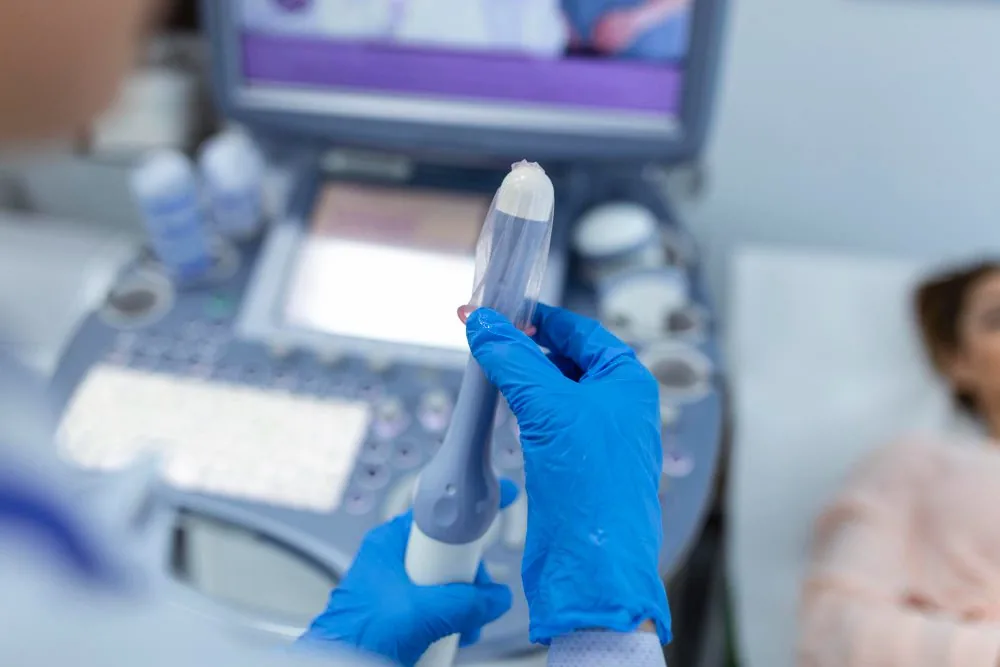
During an abdominal ultrasound, the probe moves over the abdomen. During a transvaginal ultrasound, a specially designed slender probe is carefully inserted into the vagina.
Because the probe is closer to the organs being examined, it can help provide a more detailed assessment of the uterus and ovaries in particular.
How Is a Transvaginal Ultrasound Performed?
How is a transvaginal ultrasound performed? This is one of the most common questions among women having the examination for the first time.
You will usually be asked to empty your bladder before the examination.
You lie on your back on the examination couch, with your knees bent in a position suitable for a gynecological examination.
A protective cover is placed over the transvaginal ultrasound probe, and a suitable gel is applied.
The probe is inserted slowly and carefully into the vagina.
The doctor changes the angle of the probe to examine the uterus, endometrium, ovaries and other pelvic structures from different angles.
The images are viewed in real time on the ultrasound screen.
How Long Does a Transvaginal Ultrasound Take?
The duration may vary depending on the problem being assessed.
A routine transvaginal ultrasound can often be completed within a few minutes. A more detailed examination may take longer.
If a finding needs closer assessment, the doctor may take additional images from different angles and perform measurements.
The examination therefore does not take the same amount of time for every patient.
Does a Transvaginal Ultrasound Hurt?
“Does a transvaginal ultrasound hurt?” is one of the most frequently asked questions.
For most people, a transvaginal ultrasound does not cause significant pain. However, pressure or mild discomfort may be felt as the probe is inserted.
The degree of discomfort varies from person to person.
Vaginal dryness, infection, excessive pelvic floor muscle tension, vaginismus, vulvar sensitivity or existing pelvic pain can make the examination more uncomfortable.
What Should You Do If It Hurts?
Tell your doctor if you feel pain during the ultrasound.
The examination can be slowed down or stopped when necessary to maintain your comfort.
Gynecological examinations and transvaginal ultrasounds should be carried out with ongoing communication with the patient.
There is no need to force the examination to continue despite severe pain.
How Does a Transvaginal Ultrasound Differ from an Abdominal Ultrasound?

The pelvic organs can be examined by ultrasound through either the abdomen or the vagina.
However, the way the two methods are performed and the images they provide differ.
Transabdominal Pelvic Ultrasound
During an abdominal ultrasound, the probe moves over the lower abdomen.
A full bladder is often requested to help provide clearer images of the pelvic organs.
The full bladder can act as an acoustic window, helping ultrasound waves reach the pelvic region.
Transvaginal Ultrasound
During a transvaginal ultrasound, the probe is placed inside the vagina.
Because it is closer to the uterus and ovaries, it can provide a more detailed assessment of certain pelvic structures.
An empty bladder is usually preferred for this examination.
Which Method Is Better?
There is no single answer that applies to everyone.
A transvaginal ultrasound may provide more detailed information in some situations, while an abdominal ultrasound may be sufficient for some patients.
When needed, the two methods can also complement each other.
What Can a Transvaginal Ultrasound Assess?

A transvaginal ultrasound can be used to assess many structures of the female reproductive system.
Uterus
The examination can assess the following features of the uterus:
- Size
- Shape
- Position
- Muscle layer
- Structural features
These aspects can be examined during the scan.
The scan can also assess whether uterine growths such as fibroids are present.
Endometrium
The endometrium is the tissue lining the inside of the uterus.
A transvaginal ultrasound can assess its appearance and thickness.
Endometrial assessment can be particularly important in cases of abnormal uterine bleeding, irregular periods and bleeding after menopause.
The significance of endometrial thickness varies according to factors such as age, the stage of the menstrual cycle and menopausal status.
A measurement in millimeters on an ultrasound report should therefore not be interpreted in isolation.
Ovaries
The size and appearance of the ovaries and the structures within them can be assessed.
Ultrasound can examine follicles, ovarian cysts and other adnexal findings.
Cervix
The cervix, or neck of the uterus, can also be assessed during a transvaginal ultrasound.
In particular, a transvaginal ultrasound can be used to measure cervical length in certain clinical situations during pregnancy.
When Might a Transvaginal Ultrasound Be Requested?
A transvaginal ultrasound is not an examination used to diagnose just one disease.
It can help assess a range of gynecological symptoms and conditions.
These may include:
- Irregular periods
- Abnormal vaginal bleeding
- Bleeding between periods
- Pelvic pain
- Suspected ovarian cysts
- Assessment of fibroids
- Assessment of the endometrium
- Investigation of infertility
- Monitoring ovulation
- Assessment of early pregnancy
- Suspected ectopic pregnancy
- Bleeding after menopause
These are among the situations in which it may be used.
The decision to perform a transvaginal ultrasound takes the patient's symptoms and examination findings into account.
Why Is a Transvaginal Ultrasound Used for Irregular Periods?

Irregular periods can have many different causes.
Alongside hormonal causes, assessment may need to investigate polyps, fibroids, ovarian cysts or conditions involving the endometrium.
A transvaginal ultrasound can provide important information about the uterus, endometrium and ovaries as part of this assessment.
However, ultrasound alone cannot identify every cause of irregular periods.
Hormone tests, a pregnancy test or other investigations may be added when needed.
Can a Transvaginal Ultrasound Detect Ovarian Cysts?
Yes.
Transvaginal ultrasound is commonly used to assess ovarian cysts.
During the scan, the following cyst features can be assessed:
- Size
- Internal structure
- Fluid-filled or solid characteristics
- Wall structure
- Relationship to surrounding tissues
These features help characterize the cyst.
Not every ovarian cyst requires surgery or treatment.
Some functional cysts, particularly during the reproductive years, may resolve on their own.
Ultrasound findings should therefore be interpreted alongside the person's age, symptoms and clinical situation.
Can a Transvaginal Ultrasound Detect Fibroids?
Uterine fibroids can be seen during a transvaginal ultrasound.
Their location within the uterus, size and number can be assessed.
This information can help guide management, particularly in situations involving heavy periods, pelvic pressure or pregnancy planning.
However, finding a fibroid does not automatically mean that treatment is necessary.
Treatment decisions take the person's symptoms and the characteristics of the fibroid into account.
Can a Transvaginal Ultrasound Be Performed During Your Period?
It can be performed when needed.
Menstrual bleeding does not absolutely prevent a transvaginal ultrasound.
For some gynecological assessments, a scan at a particular stage of the menstrual cycle may actually be preferred.
The best day for the scan may depend on its purpose.
There is therefore no general rule that transvaginal ultrasound must never be performed during menstruation.
Can a Transvaginal Ultrasound Be Performed During Pregnancy?
Yes.
Transvaginal ultrasound can also be used during pregnancy and can provide important information, especially in early pregnancy.
It may be used to assess the gestational sac inside the uterus in early pregnancy and, as pregnancy progresses, the embryo.
Can a Transvaginal Ultrasound Cause a Miscarriage?
There is no scientific evidence that a standard diagnostic transvaginal ultrasound causes pregnancy loss.
The probe is placed in the vagina; it does not enter the uterus or the gestational sac.
It is therefore one of the imaging methods that can be used safely in early pregnancy when the doctor considers it necessary.
Can It Be Used If an Ectopic Pregnancy Is Suspected?
Yes.
Transvaginal ultrasound is an important method for assessing whether an early pregnancy is located inside the uterus.
However, very early in pregnancy, the gestational sac may not yet be visible.
In this situation, gestational age, beta-hCG levels, symptoms and repeat ultrasound assessments, when needed, are considered together.
Does a Transvaginal Ultrasound Involve Radiation?
No.
Ultrasound uses high-frequency sound waves to produce images.
It does not involve the ionizing radiation used in X-rays or CT scans.
Transvaginal ultrasound therefore works through sound waves rather than exposure to ionizing radiation.
Should Your Bladder Be Full Before a Transvaginal Ultrasound?
Usually not.
An empty bladder is generally preferred for a transvaginal ultrasound.
This differs from a transabdominal pelvic ultrasound.
For an abdominal ultrasound, a full bladder is often requested to improve the view of the pelvic organs.
In some assessments, an abdominal scan is performed first with a full bladder, followed by a transvaginal scan after the bladder has been emptied.
Is Special Preparation Needed Before a Transvaginal Ultrasound?
Most routine transvaginal ultrasounds do not require extensive preparation.
Emptying your bladder before the examination is usually sufficient.
However, your doctor may give different preparation instructions if the ultrasound is part of a specific treatment, pregnancy monitoring or a specialized gynecological assessment.
Can Someone Who Has Never Had Sexual Intercourse Have a Transvaginal Ultrasound?
Patients often ask this question, and it should be handled sensitively.
First, “virginity” cannot be reliably determined through a physical examination or the appearance of the hymen.
The structure of the hymen varies from person to person.
Transvaginal ultrasound is an invasive imaging examination involving a probe placed inside the vagina. For someone who has not previously experienced vaginal penetration, the need for the examination, alternative imaging methods and the person's preferences should therefore be considered together.
A transvaginal ultrasound should not be performed without the person's informed consent.
Can a Transvaginal Ultrasound Affect the Hymen?
Because the probe must be inserted into the vagina, contact with hymenal tissue is possible.
The shape, elasticity and opening of the hymen vary considerably, so the effect cannot be assumed to be the same for everyone.
Anyone concerned about the hymen should discuss this openly with their doctor before the examination.
Alternative imaging methods, such as an abdominal ultrasound, can be considered when appropriate.
Does the Hymen Show Whether Someone Has Had Sexual Intercourse?
No.
The appearance of the hymen cannot scientifically and reliably establish whether someone has had sexual intercourse.
Hymenal anatomy naturally varies, and its appearance is not evidence of a person's sexual history.
So-called “virginity testing” therefore has no scientifically reliable anatomical basis.
Can a Transvaginal Ultrasound Be Performed in Someone with Vaginismus?
A transvaginal ultrasound may be uncomfortable or difficult to perform in people with vaginismus or marked pelvic floor muscle contractions.
It is important to explain the examination, avoid rushing and respect the person's boundaries.
There is no universal rule that a transvaginal ultrasound must always be completed.
Depending on the clinical need, an abdominal ultrasound or other imaging options can be considered.
Can There Be Bleeding After a Transvaginal Ultrasound?
Most people do not experience bleeding after a transvaginal ultrasound.
Rarely, sensitive vaginal or cervical tissue may cause light spotting.
In situations such as bleeding during pregnancy or after menopause, existing bleeding should not be assumed to have been caused by the scan.
Contact your doctor if bleeding is unexpected, persistent or significant.
Can a Transvaginal Ultrasound Establish a Diagnosis on Its Own?
Not always.
Ultrasound is an important imaging method, but the images are interpreted alongside symptoms, a gynecological examination and laboratory tests when needed.
For example, seeing an ovarian cyst does not always definitively establish its type.
Similarly, the significance of a thickened endometrium varies with age, the menstrual cycle and menopausal status.
Ultrasound images should therefore be considered as part of the clinical assessment.
Frequently Asked Questions About Transvaginal Ultrasound
How Many Minutes Does a Transvaginal Ultrasound Take?
A routine examination is usually brief. Its duration depends on the structures being assessed and the findings.
Is a Transvaginal Ultrasound Painful?
Significant pain is not expected for most people, although pressure or discomfort may occur. Tell the doctor if you feel pain.
Can a Transvaginal Ultrasound Be Performed During Menstruation?
Yes. It can be performed during your period when clinically needed.
Can a Transvaginal Ultrasound Be Performed During Pregnancy?
Yes. It is commonly used, particularly for assessing early pregnancy.
Does a Transvaginal Ultrasound Involve Radiation?
No. It uses sound waves to produce images.
Do You Need a Full Bladder for a Transvaginal Ultrasound?
Usually not. An empty bladder is generally preferred for the transvaginal examination.
Can a Transvaginal Ultrasound Show Cysts and Fibroids?
It is one of the imaging methods commonly used to assess uterine fibroids and ovarian cysts.
Transvaginal Ultrasound Is an Important Part of Gynecological Assessment
A vaginal ultrasound, also called a transvaginal ultrasound, helps provide a detailed assessment of the uterus, endometrium, ovaries, cervix and surrounding pelvic structures.
It can be used in many situations, including irregular periods, abnormal bleeding, pelvic pain, ovarian cysts, fibroids and early pregnancy.
Much of the anxiety behind the question “How is a transvaginal ultrasound performed?” may come from not knowing what to expect. The examination is usually brief and does not cause significant pain for most people. However, individual sensitivity, vaginal dryness and the condition of the pelvic floor muscles can affect discomfort.
It can be used during pregnancy when needed and does not involve ionizing radiation.
For people who have not previously experienced vaginal penetration, the need for the scan, alternative imaging methods and personal preferences should be considered together. Providing information and obtaining consent are essential in every case.
At Dr Tuba Nadide Yılmaz's Clinic, examinations and any necessary ultrasound scans for irregular periods, pelvic pain, ovarian cysts, fibroids, pregnancy and other gynecological concerns can be planned according to the individual's clinical situation.
Contact us to discuss an appropriate treatment plan.
We are here for your questions
Contact our clinic for information and appointment requests.
Contact the clinic